CM3121 - Advanced Organic Chemistry
Academic Year 25/26 - Semester 1
Assessments:
-
CA1: 25%
-
CA2: 25%
-
Finals: 50%
Lecturer(s): Asst. Prof. Zhu Ye
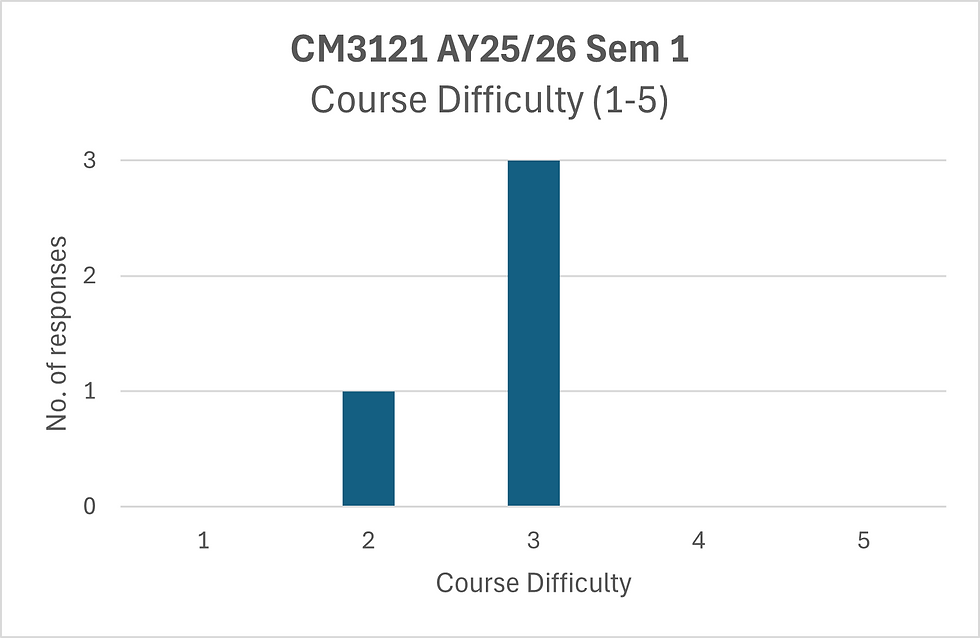
No. of responses : 4
REVIEWS
What advice would you give to someone considering to take this course?
Anonymous: Have consistent practice and do not wait till the last weeks.
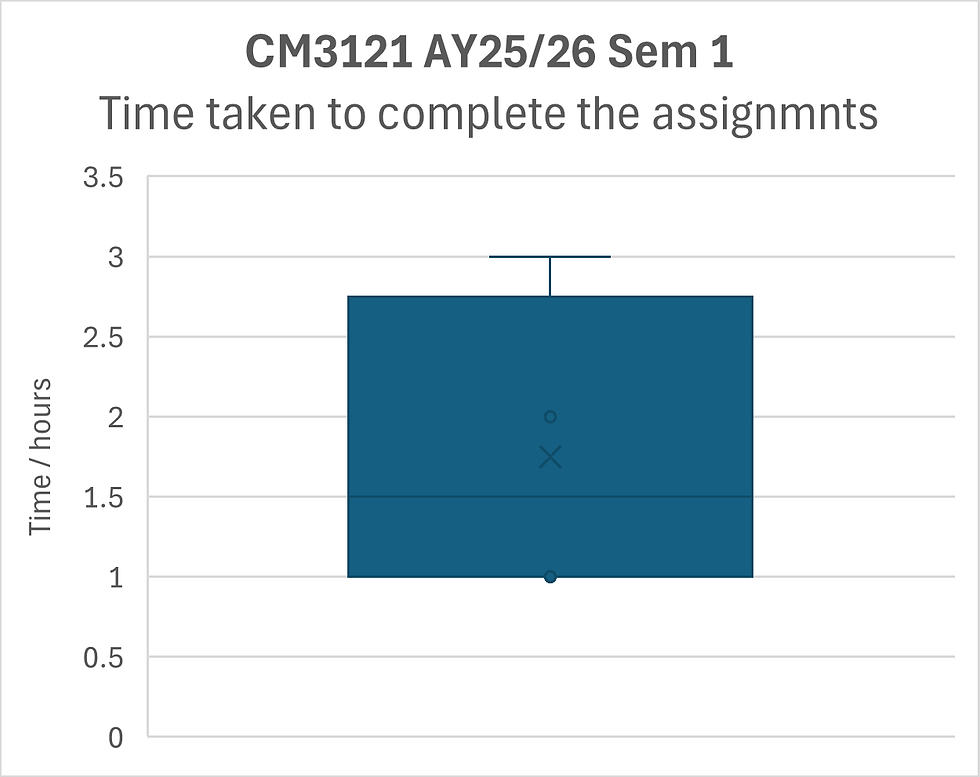
George: Compared to CM2122, CM3121 is considerably lighter in terms of workload. Lecture tests and the final exam allow an A4 bring-in reference sheet. There are only 6 tutorials for this course, on weeks 3-5 and weeks 7-9. Mechanisms and synthesis are covered. Spectroscopy from CM2122 is not covered. If you take this course under Prof Zhu Ye, the focus will be on (retro)synthesis.
Anonymous: Do practices, do not just blindly remember reagents and conditions. Cheat sheet is provided so if stuck on trying to do retro synthesis, look at cheat sheet
DolleEicir: Following CM2122, which has a good portion focused on reaction mechanisms, CM3121 is the extension of that, which focuses more on various important organic reactions, classified as 3 groups: polar, pericyclic and radical reactions. More than learning the reaction conditions and reagents used, it is also a good habit to practice through the reaction mechanisms for each step, and rationalise through why certain mechanisms/ sites are preferred, to apply to more complicated examples present in tutorials/ tests/ exams. Regarding cheatsheet, prepare it in a way that helps you to easily identify the possible reactions that are used, and concepts/ details that are more obscure/ memory-based, rather than just listing out every reaction taught/ tested with as much details as possible. Practice until you can be rather confident to do questions with minimal to no reference to the cheatsheet.
What did you enjoy or find most useful from this course?
Anonymous: Prof Zhu Ye is very helpful and caring by involving lots of practice questions during lecture to ensure you understand. Alongside this, the tutorials are very aligned to what was covered in lecture and correspondingly, the tests.
George: Under Prof Zhu Ye, lectures begin and end with a summary of the intended learning outcomes, which is extremely beneficial. His tutorials are also effective as they begin with 15 mins of group discussion, followed by presenting your group's solution. Prof Zhu Ye also walks around the class during the group discussion to look through and comment on students' solutions, which is helpful as there are often numerous possible routes to obtain a target molecule. He also takes the initiative to share why your proposed route might or might not work in practice. You should attend all tutorials, even if you have not attempted the questions, as you would be able to learn something from your peers as they share their thought process during the group discussion.
Anonymous: I love Prof Zhu Ye’s teaching style and pace. I also enjoyed the content
DolleEicir: Following CM2122, which has a good portion focused on reaction mechanisms, CM3121 is the extension of that. Content is sufficient for undergraduate students that require an intermediate understanding of organic chemistry. Plus, Prof Zhu Ye is really nice and helpful.
What aspects of the course did you find most challenging, and why?
Anonymous: The challenging part of this module would be synthesis pathway questions as some of the questions are quite unintuitive without guess and check from the few initial starting materials.
George: Visualising the 3D structures of fused and bicyclic compounds may be a challenge for some students, given that pericyclic reactions form a third of the course. Standard molecular modelling kits, such as those sold by CSS, are generally not helpful as building complex cyclic compounds is near impossible.
Anonymous: Retrosynthesis. It is hard to come up with a synthetic route under exam conditions
DolleEicir: It takes time to look through the content learnt and connect the dots between lectures.
What resources did you find most helpful in helping you better understand the course material?
Anonymous: Reviewing PYPs may be good for relevant questions but some questions may not be relevant since content varies slightly year to year.
George: Prof Zhu Ye's lecture slides are very clear and concise. He also mentions which chapters from Clayden's organic textbook to refer to for students who wish to acquire a deeper comprehension of the contents.
Anonymous: Just the lecture slides and practice questions are sufficient
DolleEicir: Asking Prof Zhu Ye is probably the best, apart from organic chemistry websites, YouTube videos and the Clayden textbook.
What other courses do you think should be taken before or concurrently with this course?
Anonymous: CM3191-organic synthesis part would be greatly helped by the content knowledge.
George: The contents of CM3121 are directly related to virtually every organic chemistry elective course, and therefore, CM3121 should be taken before any CM322X or CM422X, even if CM2122 is the only stated prerequisite.
Anonymous: 2122 because that’s the pre-req
DolleEicir: It's pre-requisite, CM2122, should be more than sufficient.