CM2143 - Basic Toolkit of Analytical Chemistry
Academic Year 25/26 - Semester 1
Assessments:
-
CA1: 25%
-
CA2: 30%
-
Unannounced Lecture Quiz: 5%
-
Lab Reports: 4×8% = 32%
-
Viva: 8%
Lecturer: Dr Tan Wee Boon
Lab Instructor: Dr Jeremiah Chen
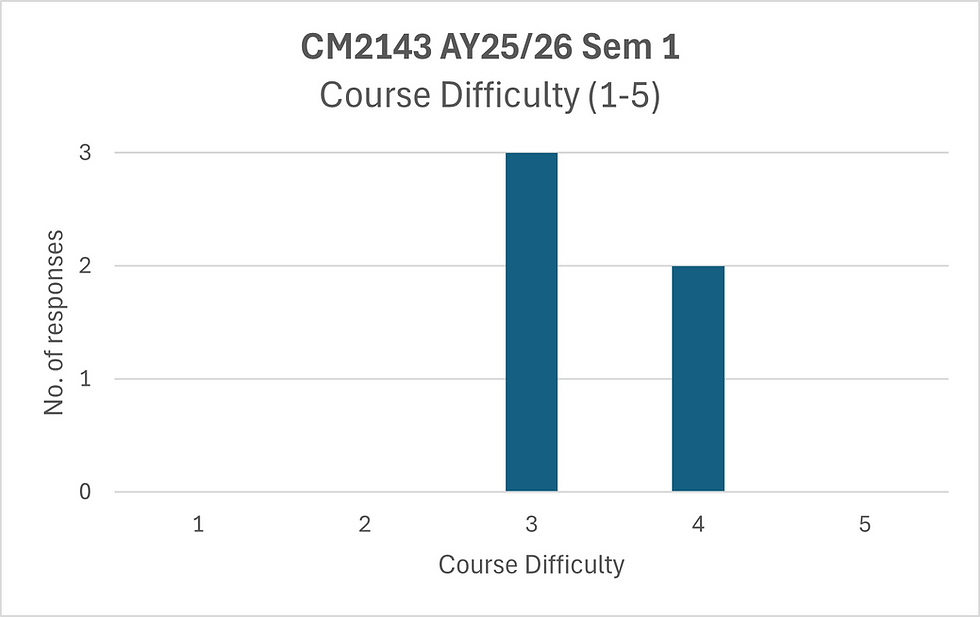
No. of responses: 5
REVIEWS
What advice would you give to someone considering taking this course?
Anonymous: Cheatsheets take a long time to make. Make one and update it regularly, focus on understanding concepts and doing practice questions before tests.
George: This course features 4 lab practical sessions, with the 5th allocated lab slot being an oral viva (your timeslot is allocated). Compared to CM2112 and CM2122, lab sessions for CM2143 tend to end earlier, generally by 2.30pm. Your lab groupings (3-4 per group) are decided on alphabetical ordering. You should not spend too much time on the lab reports and pro formas as they are not very differentiating; the entire cohort gets between B+/A-. All theory is taught by Week 6 (which makes lectures feel very fast) and lab sessions are all in the second part of the semester, with only lecture tests using the lecture slots after Week 7. You should plan your timetable with this in mind.
periodically.j: Half of the content is formulas and the other half is more practical in the sense of how the various analytical methods have different case uses so it's good to work on understanding them.
Anonymous: I would advise them to try to really understand the concepts because the 43 is doable if you put in regular effort. The cheatsheet for the test is crucial so start on early and spend time to trial and error and do the past year papers to see how the prof set the questions. For lab, consult Jeremiah if unsure about anything he is quite nice and patient to explain concepts and rationale to you. And please please know your theory stuff and watch lab videos before going to lab to not be blur during lab, which can slow down your group mates too.
Anonymous: Be prepared for labwork.
What did you enjoy or find most useful from this course?
Anonymous: Lectures ended by recess week, giving me time to focus on revision and lab submissions. Lab was enjoyable since it was done in groups of 3 and Dr Chen/TAs were approachable when we had questions.
George: The instrumental methods covered in CM2143 (GC, LC, voltammetry) are relevant for both research and industry. The lab experiments are:
1. Quantification of small organics using GC (with FID)
2. Quantification of tartrazine and caffeine using LC
3. Method comparison between potentiometric and Volhard titration
4. Quantification of ferricyanide using CV and LSV
periodically.j: The labs were quite cool to be able to get a little bit of hands-on with the equipment we have in NUS.
Anonymous: I found the stats part was quite useful if you're an analytical chemist; learning different chromatography techniques is also useful as they are very common in the Chemistry field.
Anonymous: Labs were fun and you get to learn a lot about the different analytical techniques.
What aspects of the course did you find most challenging, and why?
Anonymous: Some parts of lab pro-formas were tedious, need a good understanding of the concepts. The CAs require some general chemistry knowledge (e.g. volatilities of substances), so cannot just rely on lecture content but need practice.
George: Both the lecturer (Dr Tan Wee Boon) and the lab instructor (Dr Jeremiah) are extremely clueless about the course contents. While the latter is approachable, both Dr Tan and Dr Jeremiah are severely lacking in their theoretical knowledge about this field, and students often need to resort to online sources or AI to (inadequately) resolve their doubts. Both seem to be going through the motion without comprehending the concepts that they are teaching. Dr Tan's lecture slides are completely plagiarised from ChemLibreTexts and consequently are haphazard, disorganised and worryingly too often, inaccurate. When students approach him to clarify a point they feel might be inaccurate, he simply retorts that analytical chemistry was not his PhD and that is not an important point. Worringly, some of said inaccuracies are tested, such as his misuse of statistics and his misconceptions revolving around statistical independence. Dr Tan underutilises the Canvas page and does not specify the intended learning outcomes or the items he would test. This makes it challenging for students to study for the course, as his slides contain extreme amounts of technical details, as expected from slides which have been entirely copied from ChemLibreTexts. Instead of differentiating based on conceptual or Chemistry knowledge, the bulk of Dr Tan's test questions are calculations-based. This is probably because one needs to have theoretical knowledge to set theory-based questions. His test questions give an unreasonable amount of time to complete extremely tedious calculations, such as performing linear regression from 5 points by hand in AY24/25, or solving a 3-equation, 3-unknown simultaneous equation in AY25/26 under timed conditions of the lecture tests, which are not only tangential to analytical chemistry, but can also be done with ease using ChatGPT and an Excel sheet in real life. His open-ended questions are no better, as he does not specify the number of marks for each question, leaving students unsure of how much to write for each explanation question. He often has 4+ marking points for a "briefly explain" question, with the acceptable answers overfitted to his lecture slides: He openly shouted at a student (yes, you heard that right: shouted) after a lecture for providing an answer that was not on the slides, saying "This is found on the slides. Why can't you be like everyone else who has written that? I am the setter, and I have the authority to decide what is accepted!"
Dr Jeremiah, while not as insufferable, is equally ignorant about analytical chemistry. This is extremely apparent in the latter 2 lab sessions involving electrochemistry, where he struggles to explain fundamental concepts such as the factors limiting Faradaic current (mass transport vs kinetically limited) and the Chemistry principles behind each method. Students should not expect the same level of competence as Dr Jeremiah compared to the explanations provided behind the principles of other instruments covered during the lab sessions of CM2122 (eg: if you asked Dr Hoang how NMR spectroscopy works in CM2122, or Dr Chui how microscopy works in CM2112, they would both be able to clarify all your doubts, as they both posses the minimum prerequite knowledge unlike those teaching CM2143).
Similar to Dr Tan, Dr Jeremiah also misuses statistics and fails to understand foundational quantitative ideas in analytical chemistry. This is evident in his pro forma questions, involving serious errors such as extrapolating beyond calibration regions (with no concrete qualitative or quantitative justifications) and hypothesis testing between two samples of n=2 (students struggle to understand what a standard deviation even means with n=2). He practices negative marking for lab submissions, and additional rigour is not credited; getting ticks for every question will still land you an A-, the highest grade of the cohort for most lab submissions. Overall, CM2143 is a "don't think, just do" (and blindly apply) course, where students can easily do well by regurgitating formulas without understanding their theoretical underpinnings. It is comparable to analysing an NMR spectrum by referencing a table, with no knowledge about what integration peaks, splitting patterns, or chemical shifts, refer to. One can effectively black box, ironically, all the analytical chemistry, into a set of formulae.
periodically.j: Understanding the analytical methods was quite a bunch of content to understand and remember in a short period of time.
Anonymous: Stats was challenging to understand and apply different formulae, but cheatsheet does help so utilise it
Anonymous: The CAs are quite early, usually ahead of other mods. So plan ur time wisely for revision
What resources did you find most helpful in helping you better understand the course material?
Anonymous: Practice questions and past year papers uploaded by lecturer.
George: Because all of Dr Tan's slides are taken from ChemLibreTexts, you should find the website he plagiarised his slides from and read the article directly. This is because he removes entire paragraphs or sections from his slides, making them incoherent and lacking the original context. Finding the primary source that he plagiarised from is simple, as one can copy-paste an entire paragraph from any of his slides and search for it on Google. The option with a 99% similarity match is his source.
periodically.j: Some of the content can be found on YouTube to support lecture understanding.
Anonymous: lecture slides
Anonymous: Do the prac qns provided and consolidate a good cheatsheet
What other courses do you think should be taken before or concurrently with this course?
Anonymous: CM2133 or none. Workload is manageable enough to take with other mods but due to labs, it may be better to take this with a non-lab module.
George: While internships vary significantly, CM2143 should be taken before undertaking any lab-based UROPS, as ideas involving quantification and calibration would be expected knowledge.
periodically.j: CM2133
Anonymous: CM2133 for timetable
Anonymous: Cm2133 without clashes